About Seatram Logistics
What makes Seatram Logistics different from a general freight forwarder?
Seatram Logistics has worked the Italy–Australia trade lane since 1986, with direct carrier relationships at La Spezia, Genova, Livorno, and Naples — not a generic network login. That depth means we know the documentation patterns of Italian exporters, the seasonal congestion points at origin ports, and the compliance requirements that catch generalists off guard. Regardless of where your cargo is coming from, you benefit from 40 years of operational knowledge that a generalist simply cannot replicate.
We already have a freight forwarder. How difficult is switching?
In practice, switching takes hours rather than months. Seatram Logistics handles the transition, works through your existing supplier contacts, and gets your trade lanes running from day one. You do not need to rebuild institutional knowledge from scratch — we bring it.
Who will I be dealing with at Seatram Logistics?
You deal directly with our principals — not a rotating team of account managers. Manuel Pagnin, Director of Seatram Logistics, has operated on the Italy–Australia trade lane throughout his career. The same person who quotes your shipment is the person who clears it and calls you if there is a problem. There is no handoff to a call centre.
Customs & Compliance
Do you handle customs clearance in-house or use a third-party broker?
Customs clearance is handled entirely in-house by our licensed customs brokers. We review tariff classification and FTA eligibility on every shipment before it moves, not after it arrives in Australia. Tariff consultancy is included in our service — there is no separate engagement or additional fee for getting your classification right.
What documents do I need to import goods into Australia?
Most commercial shipments require a commercial invoice, packing list, bill of lading or airway bill, and a completed import declaration lodged with Australian Border Force. Depending on your goods, you may also need biosecurity permits (BICON), Conformance Assessment documents, or permits for restricted goods. Our customs team advises on documentation requirements for your specific cargo before it ships — preventing holds and delays at the border.
Does Australia have a free trade agreement with Italy?
There is currently no Australia–EU Free Trade Agreement in force, which means goods imported from Italy attract standard (Most Favoured Nation) customs duty rates. Some products attract 0% import duty regardless — our customs brokers classify every shipment to confirm the applicable rate and check whether any duty concession orders apply to your specific goods.
What is tariff classification and why does it matter?
Every product imported into Australia must be assigned a tariff classification code (based on the Harmonized System). This code determines the customs duty rate, any applicable GST treatment, biosecurity requirements, and whether permits are needed. Incorrect classification is one of the most common and costly mistakes importers make — resulting in back-payment of duties, penalties, or shipment holds. Our in-house licensed customs brokers review classification on every shipment before your cargo moves.
Services & Cargo
What is the difference between FCL and LCL sea freight?
FCL (Full Container Load) means your cargo fills an entire container — typically 20ft or 40ft. You pay for the whole container regardless of how much space you use, but your goods travel alone, with no consolidation delays. LCL (Less than Container Load) means your cargo shares a container with other shippers' goods and you pay only for the space you use. LCL suits smaller volumes but typically adds 3–7 days to transit time for consolidation and deconsolidation. Our team advises which option is more cost-effective for your cargo volume and urgency.
How long does sea freight from Italy to Australia take?
Direct FCL sea freight from Italian ports to Sydney typically takes 28–35 days port-to-port, depending on the carrier service and origin port. LCL shipments add consolidation and deconsolidation time at each end, typically 5–10 additional days. Transit times from other European origins are similar. Air freight from Italy to Sydney typically arrives in 3–7 days door-to-door. We provide estimated transit times with every quote.
Can Seatram Logistics handle oversized or out-of-gauge cargo from any origin?
Project cargo and out-of-gauge shipments are core Seatram Logistics services, not exceptions. We engineer the solution from factory or port of loading — selecting the correct equipment, flat rack, or purpose-built rig — through to Australian delivery. Marble slabs, industrial presses, tanker trailers, agricultural machinery, and superyachts have all moved through our operations.
Do you offer 3PL warehousing once cargo arrives in Australia?
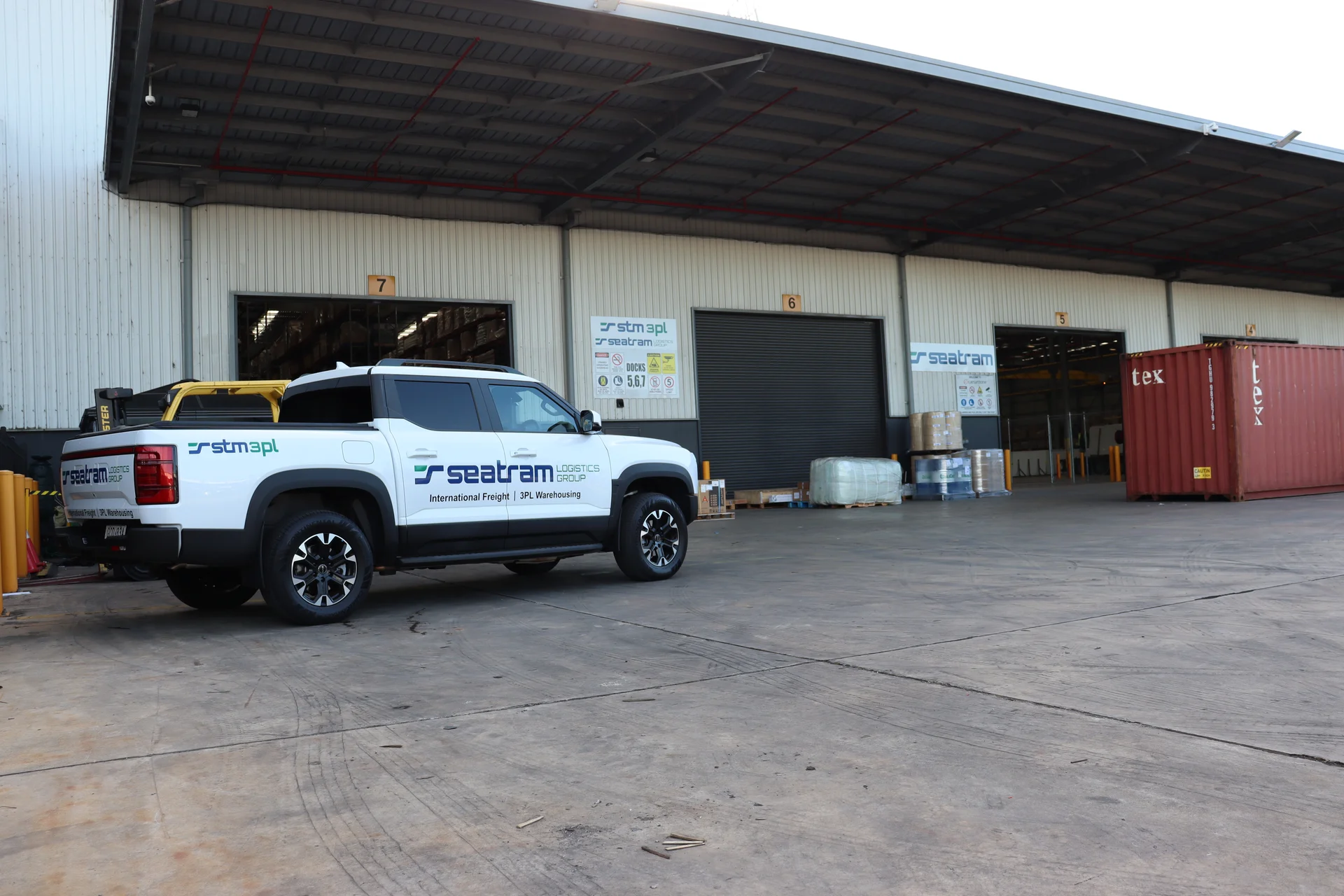
Yes. Seatram Logistics operates warehousing from Moorebank NSW, adjacent to the Moorebank Intermodal Terminal — one of Australia's largest intermodal hubs. We offer container destuffing, pick and pack, inventory management, and east coast distribution. Your cargo can move from port to our warehouse to final delivery under one operator.
Quotes & Process
How do I get a freight quote and how quickly will I receive it?
Submit your cargo details through our quote form and a freight specialist will respond by the next business day. We provide a complete landed cost estimate — including sea or air freight, destination charges, customs duties, and GST — so your cost calculation is reliable from the start.
What information do I need to provide to get a freight quote?
For a sea freight quote: cargo description, HS code (if known), origin city or port, approximate dimensions and weight (or number of pallets/cartons), and your required delivery address in Australia. For air freight, the same information applies. If you are unsure of your HS code or dimensions, our team can assist — rough estimates are enough to get started.
What direct carrier relationships do you hold at origin ports?
Our strongest origin relationships are at La Spezia, Genova, Livorno, and Naples — built over 40 years on the Italy–Australia trade lane. Beyond Italy, we hold established carrier and agent relationships across key European, Chinese, and South-East Asian ports. These are operational relationships, not broker arrangements made through a shared platform.
Still have a question?
Our freight specialists are available Mon–Fri 8:30am–5pm AEST and respond to all enquiries by the next business day.
Ready when you are
Ready to Move Your Cargo?
Our Sydney-based team handles customs, compliance, and carrier coordination — so you are not managing your forwarder on top of managing your business. Response by the next business day, no obligation.